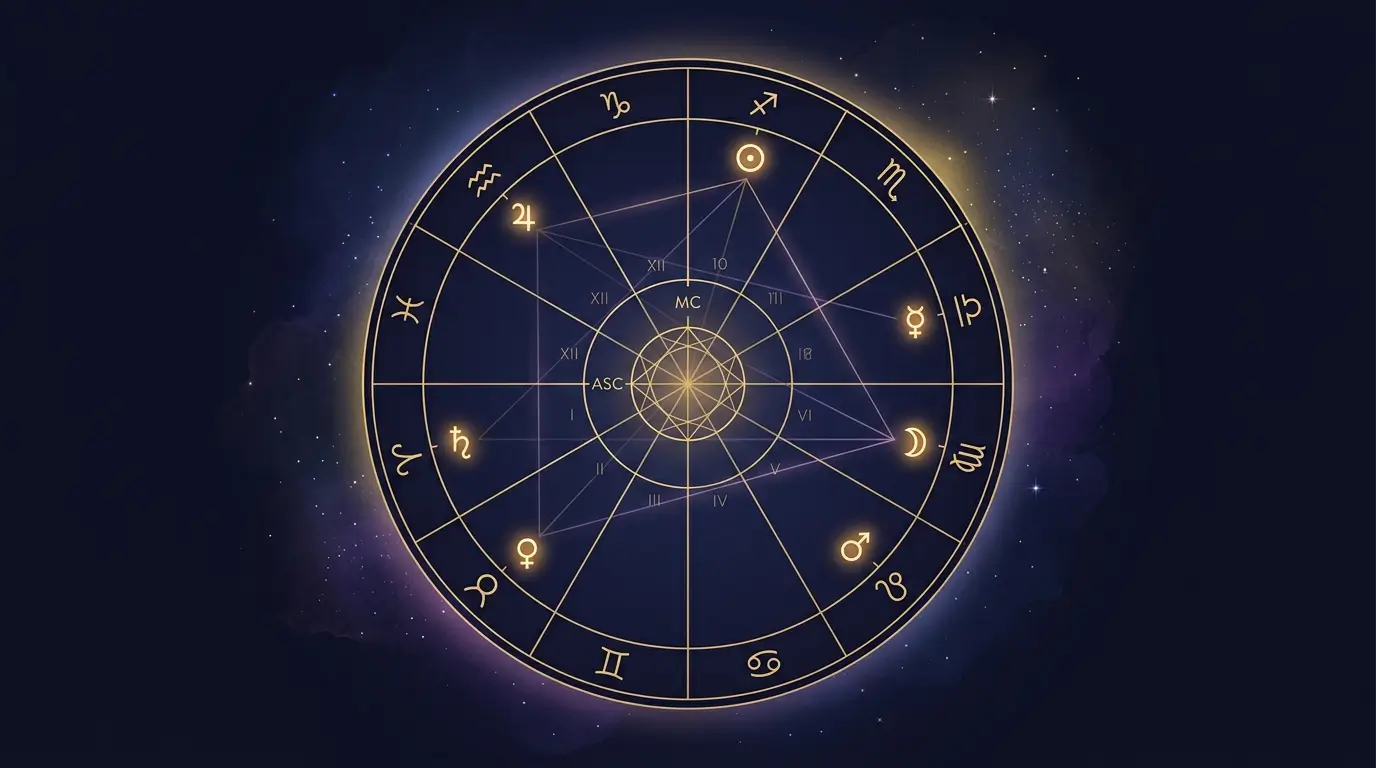
Your natal chart (also called a birth chart) is a map of the sky frozen at the exact moment you took your first breath. It records where every planet sat, which zodiac sign was rising over the eastern horizon, and how these celestial bodies related to one another. No two charts are identical. Even twins born minutes apart can end up with different Rising signs, which shifts the entire house system and changes the way planetary energy distributes across their lives.
Think of the chart as a circle divided into twelve slices (houses), populated by ten celestial bodies (planets), each sitting in one of twelve zodiac signs. These layers interact to create meaning. A planet tells you what energy is at play. The sign tells you how it expresses. The house tells you where in your life it shows up.
What You Need to Generate Your Chart
You need three pieces of information to generate your chart:
- Date of birth: day, month, year
- Exact time of birth: hours and minutes matter. Even a 15-minute difference can shift the Rising sign.
- Place of birth: the city and country, since planetary positions are calculated relative to a specific location on Earth
⚠️ If you don't know your exact birth time, you can still learn your planetary signs, but house placements and the Rising sign will be inaccurate. Check your birth certificate or hospital records. Some countries record birth time by law; others don't.
Free tools like Astro.com, Astro-Seek, or the Cometta app will generate your chart once you enter this data. You'll get a circular diagram with glyphs, lines, and numbers. It looks complex. Each piece has a clear purpose.
The Planets: What Drives You
Each planet represents a distinct psychological function, a specific part of who you are and how you operate. Astrologers split them into three tiers.
Personal Planets
These move fast through the zodiac, spending days to weeks in each sign. They shape your day-to-day personality, the traits people notice when they meet you.
- Sun. Your core identity, ego, and life purpose. The part of you that stays constant across decades. When someone asks "what's your sign?" they mean your Sun sign.
- Moon. Your emotional instincts, comfort needs, and inner world. The Sun is who you are; the Moon is how you feel. It governs your reactions before logic kicks in.
- Mercury. How you think, process information, and communicate. A Mercury in Gemini thinks in rapid-fire bursts. A Mercury in Taurus takes its time and weighs each word. Mercury also goes retrograde three times per year, which can temporarily scramble its functions.
- Venus. What you value, how you love, and what brings you pleasure. It governs both romantic attraction and aesthetic taste, from the art you like to the environments you seek out.
- Mars. Your drive, ambition, and how you handle conflict. Mars is the engine. It determines how you pursue goals and what fires you up or shuts you down.
Social Planets
Jupiter and Saturn sit between the personal and generational planets. They spend months to years in each sign, shaping broader life chapters.
- Jupiter. Growth, optimism, and where life feels expansive. Jupiter's house placement often reveals where things come easier to you, where you catch breaks that others don't.
- Saturn. Discipline, structure, and hard-won mastery. Saturn's placement marks the area of life where you face recurring challenges, but also where you build your strongest competence over time.
💡 Saturn gets a bad reputation as the "taskmaster," but professional astrologers often call it the most important planet for long-term growth. The areas Saturn touches are the ones where you develop real skill, ability you forged through effort.
Generational Planets
Uranus, Neptune, and Pluto move so slow that entire generations share the same sign placement. Their house placement, unique to your birth time, matters more than the sign for personal interpretation.
- Uranus. Rebellion, innovation, and sudden change. Its house shows where you break conventions and resist conformity.
- Neptune. Imagination, spirituality, and illusion. Its house shows where you dream big but may also deceive yourself.
- Pluto. Transformation, power, and psychological depth. Its house marks the area of life where you undergo the most radical change across your lifetime.
The Twelve Houses: Where Life Happens
Houses divide your chart into twelve sectors, each tied to a specific life domain. The house system starts with the Ascendant (Rising sign), the zodiac sign that was climbing over the eastern horizon at your birth. This becomes the cusp of the 1st house, and every subsequent house follows counterclockwise around the chart.
The first six houses deal with your inner development. The last six deal with your relationship to others and the wider world.
Houses 1–6: The Personal Houses
- 1st House, Identity. Your appearance, first impressions, physical constitution, and the lens through which you approach everything. Planets here dominate your personality.
- 2nd House, Resources. Money, possessions, self-worth, and what you value. Material security and your relationship to what you own.
- 3rd House, Communication. How you think, speak, and learn. Also covers siblings, neighbors, short trips, and early education.
- 4th House, Roots. Home, family, ancestry, and your private emotional foundation. The bottom of the chart, its most private sector.
- 5th House, Creation. Self-expression, creativity, romance, children, and pleasure. Anything you do for the joy of doing it.
- 6th House, Routine. Daily work, health habits, service, and the grind of maintaining your body and life.
Houses 7–12: The Interpersonal Houses
- 7th House, Partnership. One-on-one relationships: romantic, business, or adversarial. Whoever stands across from you.
- 8th House, Transformation. Shared resources, debt, inheritance, sex, death, and psychological rebirth. The territory nobody talks about at dinner.
- 9th House, Expansion. Higher education, philosophy, long-distance travel, religion, and publishing. Your search for meaning beyond the familiar.
- 10th House, Career. Public reputation, professional achievement, authority, and your legacy. The very top of the chart, its most visible sector.
- 11th House, Community. Friendships, groups, social causes, technology, and collective visions. The people and networks you align with.
- 12th House, The Unconscious. Solitude, spirituality, hidden enemies, self-sabotage, and the things you can't see about yourself.
💡 An empty house doesn't mean that area of life is inactive. No planet was transiting that sector when you were born, but you still experience that house. Its themes are colored by the zodiac sign on its cusp and the ruling planet of that sign.
The Zodiac Signs: How Energy Expresses
You know your Sun sign. But in a natal chart, every planet sits in a zodiac sign, and each combination produces a different flavor.
Signs are classified by two systems that, combined, give each sign its distinct character.
Elements (Temperament)
- Fire (Aries, Leo, Sagittarius): action-oriented, enthusiastic, direct. Fire signs initiate and inspire.
- Earth (Taurus, Virgo, Capricorn): practical, grounded, steady. Earth signs build and sustain.
- Air (Gemini, Libra, Aquarius): intellectual, social, communicative. Air signs analyze and connect.
- Water (Cancer, Scorpio, Pisces): emotional, intuitive, deep. Water signs feel and absorb.
Modalities (Operating Style)
- Cardinal (Aries, Cancer, Libra, Capricorn): initiators. They start things, launch projects, and set direction.
- Fixed (Taurus, Leo, Scorpio, Aquarius): sustainers. They maintain, persevere, and resist premature change.
- Mutable (Gemini, Virgo, Sagittarius, Pisces): adapters. They adjust, refine, and transition between phases.
Combine element and modality and each sign's personality emerges. Aries is cardinal fire, an initiator who acts fast and leads by instinct. Virgo is mutable earth, an adapter who refines practical systems with precision.
To apply this in a reading: note which elements and modalities dominate. If someone has five planets in water signs, emotional processing shapes most of their experience. Four planets in fixed signs? Stubbornness and endurance are recurring themes, for better and worse.
Aspects: How Planets Talk to Each Other
Aspects are geometric angles between planets. They reveal whether two planetary energies cooperate, clash, or merge. A planet's sign and house tell you what it does and where; aspects tell you how it interacts with everything else.
The Five Major Aspects
- Conjunction (0°). Two planets occupy the same spot. Their energies fuse into a single force. The result depends on which planets are involved. Venus conjunct Jupiter is generous and pleasure-seeking; Mars conjunct Saturn can feel like driving with the handbrake on.
- Sextile (60°). A friendly, productive angle. Sextiles create natural talent that you recognize and use, unlike trines where talent can go unnoticed. These aspects thrive on conscious effort.
- Square (90°). Tension and friction. Squares force growth by creating internal conflict between two parts of your psyche. Uncomfortable but productive. Most people's biggest achievements trace back to the pressure a square created.
- Trine (120°). Effortless flow. The two planets operate in harmony so smooth that you may take this talent for granted. Trines are gifts, but without conscious development, they remain dormant potential.
- Opposition (180°). A tug-of-war between two planets on opposite sides of the chart. Oppositions create awareness through relationship: you project one side outward and encounter it through other people. Integration requires acknowledging both ends.
✨ A chart full of trines won't outperform one full of squares. Squares generate drive and ambition. Many accomplished people have charts packed with squares. The friction kept them moving.
Orbs
Aspects don't require exact angles. An "orb" is the margin of error allowed. Most astrologers use:
- Conjunction: 8–10° orb
- Trine / Square / Opposition: 6–8° orb
- Sextile: 4–6° orb
Tighter orbs produce stronger effects. A Sun-Moon conjunction at 1° is louder than one at 9°.
The Ascendant and Chart Ruler
The Ascendant (Rising sign) deserves its own section because it serves as the entry point for the entire chart. It's the sign on the cusp of the 1st house, and it determines:
- How you present yourself to the world
- Your physical mannerisms and first impressions
- The order of houses, which life areas get which zodiac sign
The planet that rules your Ascendant sign is called your chart ruler, and its placement carries outsized significance. If your Rising sign is Scorpio, your chart ruler is Pluto (traditionally Mars). Wherever Pluto sits by house and sign tells you the life area that anchors your entire chart, the domain you're most drawn to and most challenged by.
Professional astrologers look at the chart ruler before anything else after the Big Three. Its condition, whether it's in a comfortable sign and making supportive or stressful aspects, colors the entire chart's tone.
Reading Your Chart: A Step-by-Step Process
Most working astrologers follow this sequence.
Step 1: Start With the Big Three
Identify your Sun, Moon, and Rising signs. These three give you the core structure:
- Sun = your identity and purpose
- Moon = your emotional needs and instincts
- Rising = how you meet the world and the chart's structural framework
Note which houses these three occupy. A Sun in the 10th house lives through career and public achievement. The same Sun sign in the 4th house channels that energy into home and family.
Step 2: Find Your Chart Ruler
Determine the planet that rules your Rising sign. Note its sign, house, and any aspects it makes. This planet acts as your chart's anchor.
Step 3: Check the Personal Planets
Look at Mercury, Venus, and Mars, their signs and houses. These shape your communication style, relationship patterns, and drive. Together with the Big Three, these six placements cover most of your observable personality.
Step 4: Look for Patterns
- Stelliums. Three or more planets in one sign or house. A stellium concentrates energy. A 9th house stellium points to someone whose life revolves around travel, education, or belief systems.
- Element balance. Count how many planets fall in fire, earth, air, and water. A lack of earth can mean struggles with practical follow-through. Heavy fire suggests action without pause.
- Hemisphere emphasis. Are most planets above or below the horizon? Above (houses 7–12) suggests a public, outward life. Below (houses 1–6) suggests a more private, internal focus.
Step 5: Read the Aspects
Identify the tightest aspects first. They dominate. Note:
- Which planets are involved?
- Is the aspect flowing (trine, sextile) or challenging (square, opposition)?
- Do any planets receive multiple aspects, making them focal points?
Step 6: Check Saturn and the Nodes
Saturn's house shows where life tests you on repeat, and where mastery develops if you put in the work.
The North Node (by sign and house) points toward your growth edge, the qualities and life areas you're developing in this lifetime. The South Node is opposite: familiar territory and natural abilities you already possess, but also patterns you tend to fall back on.
Step 7: Synthesize
Synthesis separates mechanical chart reading from real interpretation. You're looking for themes that repeat across multiple placements. If someone's Moon is in Scorpio, Pluto conjuncts their Sun, and their 8th house is packed, transformation and emotional intensity aren't features of the chart. They are the chart.
Don't interpret every placement in isolation. Look for the threads that connect them.
💡 Reading a chart is a skill that develops with practice. Your first attempts will feel mechanical, listing placements one by one. Over time, patterns start jumping out before you consciously analyze them. Most astrologers say it takes six to twelve months of consistent practice before chart synthesis becomes intuitive.
Common Mistakes Beginners Make
A few traps that catch people early:
- Fixating on Sun sign compatibility. Your Sun sign is one placement out of dozens. Two people with "incompatible" Sun signs can have harmonious charts when you factor in Moon, Venus, and the full aspect grid.
- Fearing Saturn, Pluto, or the 12th house. Older astrology texts painted these as negative forces. Modern practice recognizes them as areas of depth, resilience, and hard-earned wisdom.
- Ignoring house rulers. If your 7th house is empty, your partnerships aren't nonexistent. Check the sign on the 7th house cusp, find its ruling planet, and examine that planet's condition. It tells you plenty.
- Cherry-picking placements. Reading only the parts you like produces a distorted picture. The chart works as a system. Tension and harmony coexist, and both serve you.
What Your Natal Chart Cannot Do
A natal chart maps potential, not fate. It shows psychological tendencies, natural aptitudes, and recurring themes. It does not dictate what will happen to you.
Two people with identical charts (born at the same time and place) will live different lives depending on their choices, circumstances, and environment. The chart is the instrument. You are the musician.
Your natal chart is the most detailed personality map available, but it's a map, not the territory. Use it to understand your wiring, recognize patterns, and make more deliberate choices about how to direct your energy.